
Information Security Service Qualification - Why should Information Security Risk Assessment be Emphasized in Software Projects
In today's digital age, with the rapid development of information technology and the continuous intensification of information security challenges, information security services have become a solid defense line for safeguarding national security, enterprise competitiveness and personal privacy. Its service scope is extensive, ranging from the rapid deployment of emergency response to the comprehensive coverage of risk assessment, from the quick response to disaster recovery to the precise and error-free system evaluation, to the continuous guarantee of security operation and maintenance, the strict implementation of security audits, the popularization and promotion of professional security training, as well as the precise provision of personalized security consultation, all of which jointly build an impregnable wall of information security protection. This series of services not only directly enhances the efficiency of information security protection, but also, in an intangible way, promotes the steady progress of social informatization. Therefore, strengthening and standardizing the management of information security service qualifications has become a key measure to ensure information security and build a healthy service ecosystem.
Information Security Service Qualification: A bridge of professionalism and trust
The Information Security Service Qualification (CCRC), as a golden business card in the field of information security, its core value lies in the authoritative certification of the professional capabilities and service quality of service institutions. It is not only a comprehensive assessment of the overall strength of service institutions in terms of legal compliance, resource investment, management level, technological innovation, etc., but also an important trust endorsement for customers when choosing partners. Obtaining the CCRC qualification means that the service provider has passed the strict national standard review and is capable of providing high-quality and efficient solutions in all aspects of information security services, effectively resisting complex and ever-changing network threats, and safeguarding the business security of customers.
Grading and classification: Precise positioning, optimized services
The information security service qualification system adopts a three-level architecture, aiming to precisely position the strength and level of service institutions through detailed classification and grading, and meet the diverse needs of different customers. The division of eight major professional fields, ranging from security integration to operation and maintenance management, from risk assessment to emergency response, and then to software security development, disaster recovery and backup, industrial control security and network security auditing, covers all aspects of information security services. This classification and grading mechanism not only provides service institutions with a clear path for improvement, but also offers customers a more explicit and specific reference basis when choosing services.
Information Security Risk Assessment: A Wise Shield to Prevent problems before they Occur
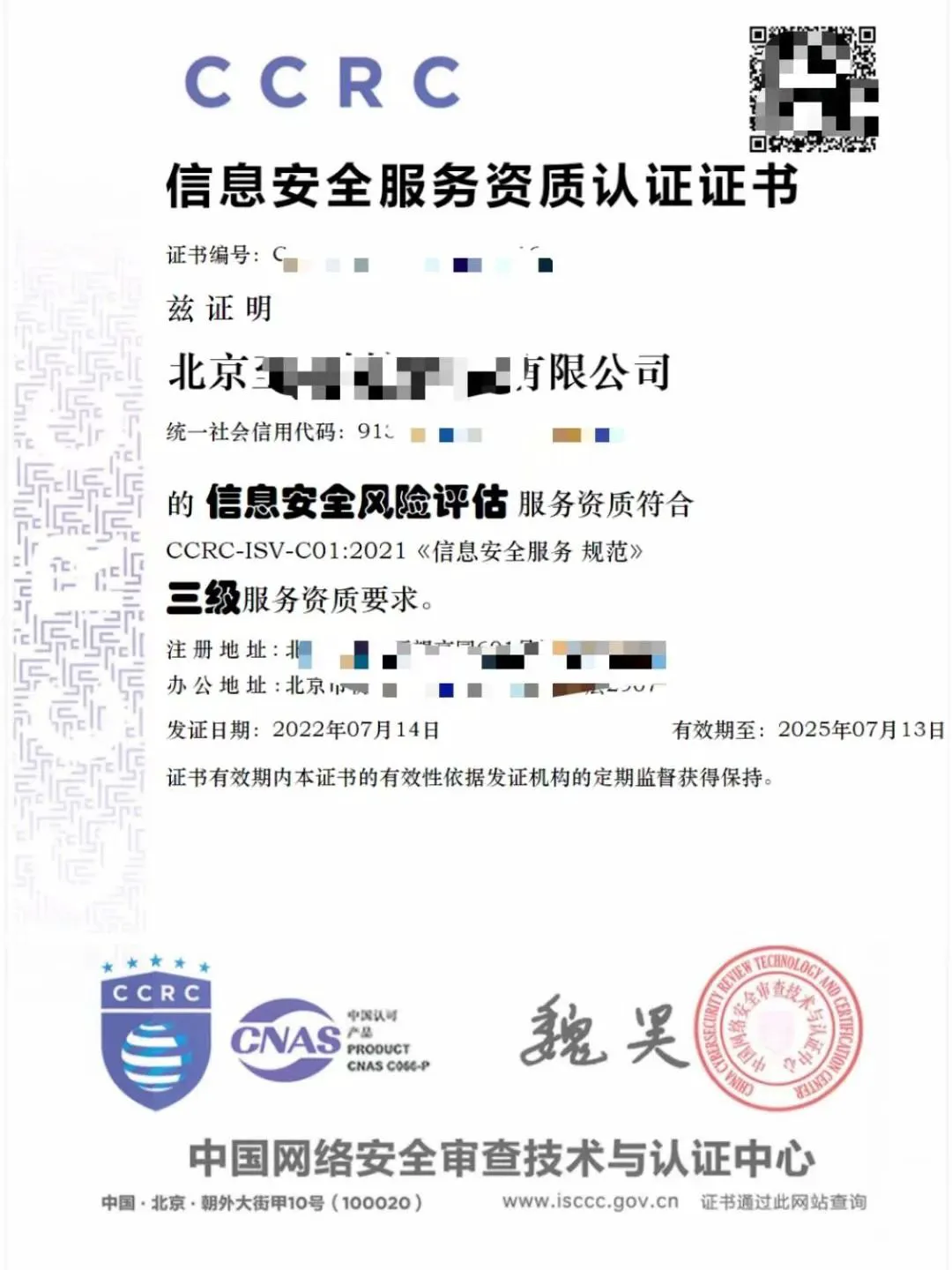
Information Security Risk AssessmentAs the core link of information security services, its significance is self-evident. It is like a shield of wisdom, capable of identifying potential safety hazards at the early stage of the project and providing timely and accurate early warning information for the project team. Through scientific methods and advanced technical means, risk assessment can deeply analyze the vulnerable points in systems and networks, evaluate the potential losses and impacts of security incidents, and thereby provide a scientific basis for formulating effective protection strategies. This process not only helps enhance the overall security of the project, but also minimizes the later repair costs and security risks to the greatest extent.
Why should information security risk assessment be emphasized in software projects
Information Security Risk AssessmentIts significance in software projects is self-evident. It is not only one of the key measures to ensure the safety of the project, but also an important way to enhance the overall competitiveness of the project, meet compliance requirements and achieve sustainable development. We should attach great importance to itInformation Security Risk AssessmentEnsure that the work runs through the entire project, providing a solid guarantee for the successful implementation and stable operation of the project.
First of allInformation Security Risk AssessmentIt is the first line of defense for the security of software projects. During the software development process, potential security threats and vulnerabilities are often hidden deep within the code and are hard to be easily detected. Through risk assessment, the project team can systematically identify these potential risks, formulate response strategies in advance, and avoid major security incidents in the later stage of the project.
Secondly, risk assessment provides a scientific basis for the formulation of security protection strategies. After understanding the threats and vulnerabilities faced by the system, the project team can design more targeted security protection plans to ensure that the system's security is maximized without affecting its performance. This risk-based protection strategy can not only effectively resist external attacks but also establish a solid defense line in internal management.
Furthermore, with the continuous improvement of cyber security regulations,Information Security Risk AssessmentIt has become a necessary step to meet compliance requirements. Many countries and regions have introduced strict laws and regulations on cyber security, requiring enterprises and organizations to comply with relevant security standards when developing and operating information systems. whileInformation Security Risk AssessmentIt is precisely one of the important means to assess whether the system complies with these standards. Through risk assessment, enterprises can ensure that their information systems comply with legal and regulatory requirements and avoid legal risks and penalties due to non-compliant operations.
Finally, regularlyInformation Security Risk AssessmentIt helps the project team continuously optimize security strategies and enhance system protection capabilities. With the development of technology and the continuous evolution of threats, the original security protection strategies may gradually become ineffective. Through regular risk assessments, the project team can promptly understand the security status and development trends of the system, and make necessary adjustments and optimizations to the security strategy. This continuous improvement mechanism can ensure that the system still maintains a strong protective capability when facing new threats, providing a strong guarantee for the long-term stable operation of software projects.