Can the software test report self-tested by a "third-party software evaluation" company be used for project acceptance?
The company's self-test report cannot replace third-party evaluation for project acceptance.

In software development projects, acceptance is a crucial step that determines whether the project can be delivered.Software Test ReportIt is an important basis for proving whether the system's functions, performance and security meet the requirements. However, some development companies or project teams, in order to save costs, attempt to conduct internal self-testingSoftware Test ReportSubmit to Party A as acceptance materials. This practice not only fails to comply with industry norms but also makes it difficult to pass the formal acceptance process. From the perspectives of policy regulations, the demands of Party A, contract terms, and the professionalism of third-party evaluation institutions, the test reports self-tested within the company are not qualified for project acceptance.
Policies and industry norms clearly require independent assessment
The state and industry authorities have clear policy requirements for the acceptance of information technology projects. For instance, the "Interim Measures for the Management of National E-Government Engineering Construction Projects" stipulates that major projects must have test reports issued by qualified third-party evaluation institutions during the acceptance stage. The core purpose of such regulations is to ensure the independence, impartiality and objectivity of the testing process.
Software systems involve multiple dimensions such as functional integrity, data security, and system stability. Any testing should avoid conflicts of interest. The developer is both the designer of the software and the tester, with a clear overlap of roles. In this case, the test results are prone to be influenced by subjective factors, and even problems such as selective testing and defect concealment may occur. The reason why the policy emphasizes third-party evaluation is precisely to prevent such risks.
Furthermore, many industry standards such as GB/T 25000.51 "Systems and Software Engineering - Quality Requirements and Evaluation of Systems and Software" also clearly stipulate that the testing activities used for acceptance should be carried out by organizations independent of the development team. These standards are widely applied in fields with high requirements for system reliability, such as government, finance, and healthcare. The self-test report of the developer fails to meet the basic requirements of "independent verification" in these standards, and thus lacks compliance.
The contract and the acceptance requirements of Party A usually exclude self-test reports

In actual projects, contract documents serve as the legal basis for defining the responsibilities of both parties and the delivery standards. Most formal project contracts clearly stipulate that "project acceptance must provide a certificate issued by a third-party evaluation agency.Software Test Report" Such terms are not optional additional conditions but the core content for safeguarding the rights and interests of Party A.
As the project investor, Party A is concerned about the availability, stability and long-term operation and maintenance support of the system. They lack the ability to conduct in-depth technical verification, and thus rely on the professional judgment of third-party institutions. If developers are allowed to use self-test reports, it is equivalent to making athletes act as referees themselves, which obviously violates the basic principle of fairness.
During the actual acceptance process, Party A or the supervision unit entrusted by it will strictly review the source of the test report. A report generated internally by the development team, even if it is detailed in content and standardized in format, is still difficult to gain recognition. Because the issuing institution lacks independence and is unable to provide qualification certificates. Many clients clearly list "third-party test reports" as essential materials in the acceptance checklist. The absence of this item is regarded as failure of acceptance.
Furthermore, for some projects, the qualification requirements for assessment institutions have been stipulated in advance in the tender documents, such as having CMA (China Metrology Accreditation),CNASCertifications such as (China National Accreditation Service for Conformity Assessment). The self-built testing teams of developers usually do not possess these qualifications, and the reports they issue also have legal validity defects. Therefore, whether from the perspective of the contractual agreement or the actual operation of Party A, the self-test report fails to meet the acceptance conditions.
The professionalism and credibility of third-party evaluation institutions are irreplaceable

The existence of third-party software evaluation institutions is precisely to address the trust issue between development and verification. Such institutions have been certified by the state and possess professional testing teams, standardized testing procedures and authoritative testing tools. They design test cases in accordance with national standards, covering multiple dimensions such as functionality, performance, security and compatibility, to ensure that the test results are comprehensive and true.
Take "Shangtuo Cloud Testing" as an example. This institution has long been serving government and enterprise informatization projects and holds dual qualifications of CMA and CNAS. Its testing process strictly adheres to the GB/T standard, and the test reports have legal effect and are widely used in project audits and acceptance. This kind of professionalism and credibility is difficult for the internal testing teams of enterprises to replicate.
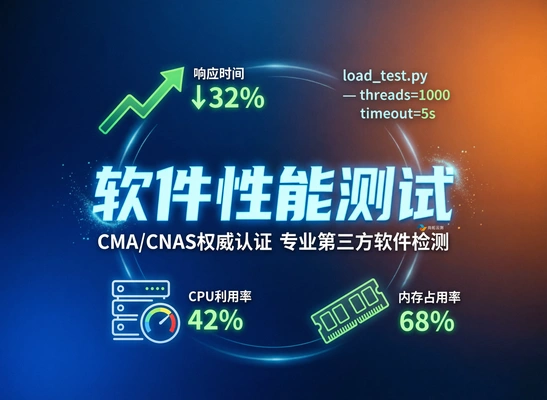
Third-party evaluations not only focus on "whether the software can be used", but also on "whether the software is stable, secure and compliant under various conditions". For example, inPerformance testIn the process, third-party institutions will simulate high-concurrency scenarios to verify the system's performance under extreme loads. In security testing, they will use professional tools to detect vulnerabilities, such as SQL injection, cross-site scripting, etc. These tasks require professional knowledge and experience accumulation, while internal testing within enterprises is often limited to functional verification and it is difficult to achieve comprehensive and in-depth coverage.
More importantly, third-party institutions have no direct interest connection with the project, and their test conclusions are more neutral. Once problems occur in the later operation of the system, the third-party test report can also serve as the basis for tracing responsibility. However, self-test reports, due to their lack of independence, are difficult to be accepted when disputes arise.
It was self-tested within the companySoftware Test ReportIt cannot be used for project acceptance, which is jointly determined by policy regulations, contract requirements, the trust mechanism of Party A and industry practices. The developer's original intention to save costs is understandable, but it cannot come at the expense of project quality and compliance. The true success of a project lies not only in on-time delivery but also in winning the long-term trust of the client through an authoritative and impartial acceptance process.
Today, with the increasing standardization of information construction, third-party software evaluation has become an important link to ensure software quality. Any attempt to replace third-party assessment with a self-test report does not meet professional standards and will not pass the formal acceptance. The project team should correctly recognize the value of the assessment, proactively cooperate with third-party institutions to complete the testing work, ensure the smooth delivery of the project, and achieve sustainable development.