
The differences between CMA-CNAS software test reports and ordinary software test reports
In the digital wave,Software Test ReportIt has become the core carrier of the enterprise's quality strategy. Especially when it comes to government regulation, cross-border trade or legal disputes,CMA/CNAS software test reportWith its technical compliance and legal effect, it forms a significant market recognition distinction from ordinary non-certified test reports. Choosing test reports with certification qualifications is not only a necessary path to meet compliance requirements, but also a strategic decision for enterprises to build quality competitiveness.
The authority of the CNAS and CMA certification systems
The technical core of the CNAS and CMA certification systems
,Legal status and regulatory mechanism
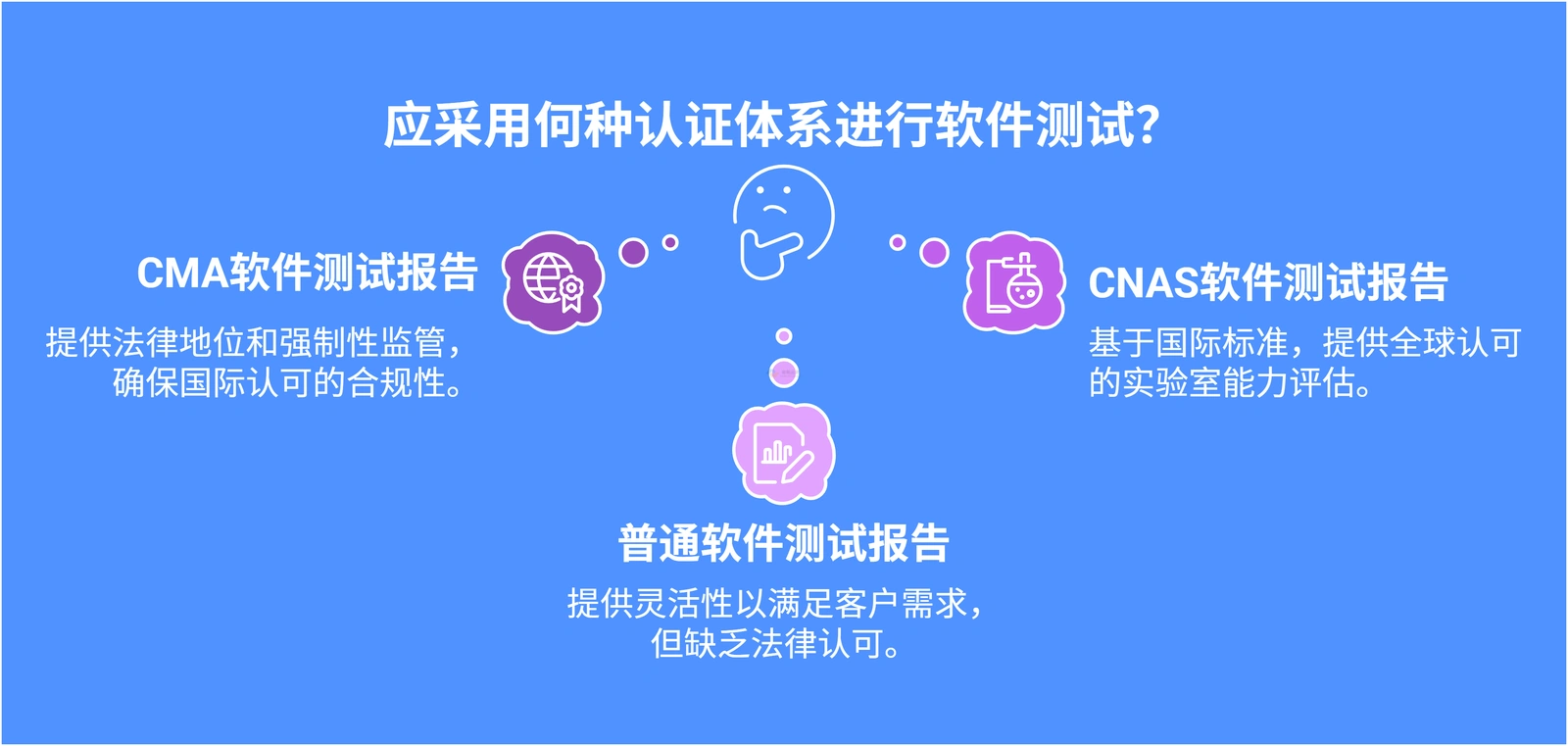
The CMA certification is established in accordance with the "Measurement Law of the People's Republic of China", and is subject to mandatory access review by provincial market supervision departments. It requires testing institutions to undergo re-review every six years to ensure continuous compliance. CNAS builds a laboratory capability assessment system based on the international standard ISO/IEC 17025. Its accreditation results are covered in over 100 economies worldwide through the ILAC international mutual recognition agreement, forming a cross-border technical trust chain.
,Technical standards and implementation requirements
CMA/CNASSoftware Test ReportIt is required that the laboratory establish a complete quality management system, including the management of all elements such as personnel qualifications (for example, the technical director should have more than 5 years of professional experience), equipment calibration and traceability, environmental control, etc. Take the assessment of measurement uncertainty as an example. The certification report must clearly state this indicator, while the ordinary report can independently choose whether to present it or not.
The flexibility and limitations of ordinary software test reports
Test documents issued by non-certified laboratories are customer demand-oriented and can respond quickly to customized testing requirements, but their validity is limited to the scope stipulated in the contract. For instance, when it comes to intellectual property disputes, ordinary reports are difficult to be accepted by courts due to the lack of third-party notarization.
Comparison of Core Differences in Software test reports
The essential difference in the hierarchy of legal effect
CMASoftware Test ReportIt has the priority of acceptance in the domestic judicial system, especially in product quality liability lawsuits, where it can be directly used as key evidence. CNAS reports demonstrate advantages in the resolution of international trade disputes. For instance, in the CE certification project for exports to the European Union, the CNAS mark can accelerate the review of customs clearance documents. In contrast, ordinary reports can only serve as technical references within enterprises and cannot break through the legal boundaries of commercial contracts.
The rigid constraints of the quality management system
Certified laboratories must implement a continuous personnel training program (such as no less than one year)16 hours of technical training, regular equipment calibration (calibration cycle accurate to the day), and standardized verification of testing methods. A case study of a medical device software shows that the CMA laboratory retested the electromagnetic compatibility test due to a 0.5% deviation in equipment calibration, while ordinary laboratories might directly use the original data.
Standardization requirements for technical specifications and report formats
CMA/CNASSoftware Test ReportEnforce the use of national standards or international standard methods, such asPerformance testGB/T 25000.51-2016 shall be followed, and the safety test shall refer to ISO/IEC 15408. In terms of report format, a certification report must include 13 core fields such as the accreditation mark, testing basis, and uncertainty statement, while a regular report allows the deletion of non-essential modules to shorten its length.
In-depth Analysis of Application Scenarios in Software Test Reports
Mandatory access in legal scenarios
In government bidding projects,CMA/CNASSoftware Test ReportIt is an essential attachment to the tender documents. Take the bidding for the smart city management system as an example. It is not stamped with the CMA or CNAS sealSoftware Test ReportIt will directly lead to the technical score being reset to zero. Export-oriented enterprises should pay more attention to the international mutual recognition value of CNAS - a certain industrial control software enterprise has passed CNASSoftware Test ReportReduce the review time for market access in the EU by 40%.
The agile application boundaries of general reports
Non-certification testing demonstrates unique value in agile development scenarios and is adopted by a certain fintech company"Dual-track testing" strategy: Use regular reports for weekly iterative defect screening in the early stage of development (saving 60% of testing costs), and entrust CNAS before product releaseThird-party software evaluation laboratoryConducting compliance verification, this hybrid model strikes a balance between efficiency and risk. Undoubtedly, it is a better approach.

Refined decision-making based on cost efficiency
Enterprises should select testing strategies based on the stages of the product life cycle, especially for start-upsThe MVP version can give priority to using regular reports, saving about 20,000 to 50,000 yuan in single test costs. After entering the stage of large-scale promotion, it must be upgraded to CMA/CNASSoftware Test ReportTo avoid legal risks. Data shows that although the certification report increases the initial cost by 30%, it can reduce the probability of product recalls to one third of that of ordinary products.
CMA/CNASSoftware Test ReportThe essential value lies in the systematic quality assurance capability - the full-chain control from personnel capabilities, equipment precision to management processes. Enterprise decisions should be based on the "scenario - cost - risk" three-dimensional model: For high-risk scenarios such as government projects and cross-border trade, certification reports must be selected. Internal research and development and prototype testing can take advantage of the flexibility of ordinary reports. With the expansion of the international mutual recognition system, qualification certification is evolving from a market access threshold to a core element of an enterprise's quality and brand. In the future, intelligent laboratories that integrate AI testing tools and certification systems may become a new benchmark for industry competitiveness.