How to apply for a software acceptance test report? Third-party software testing institutions
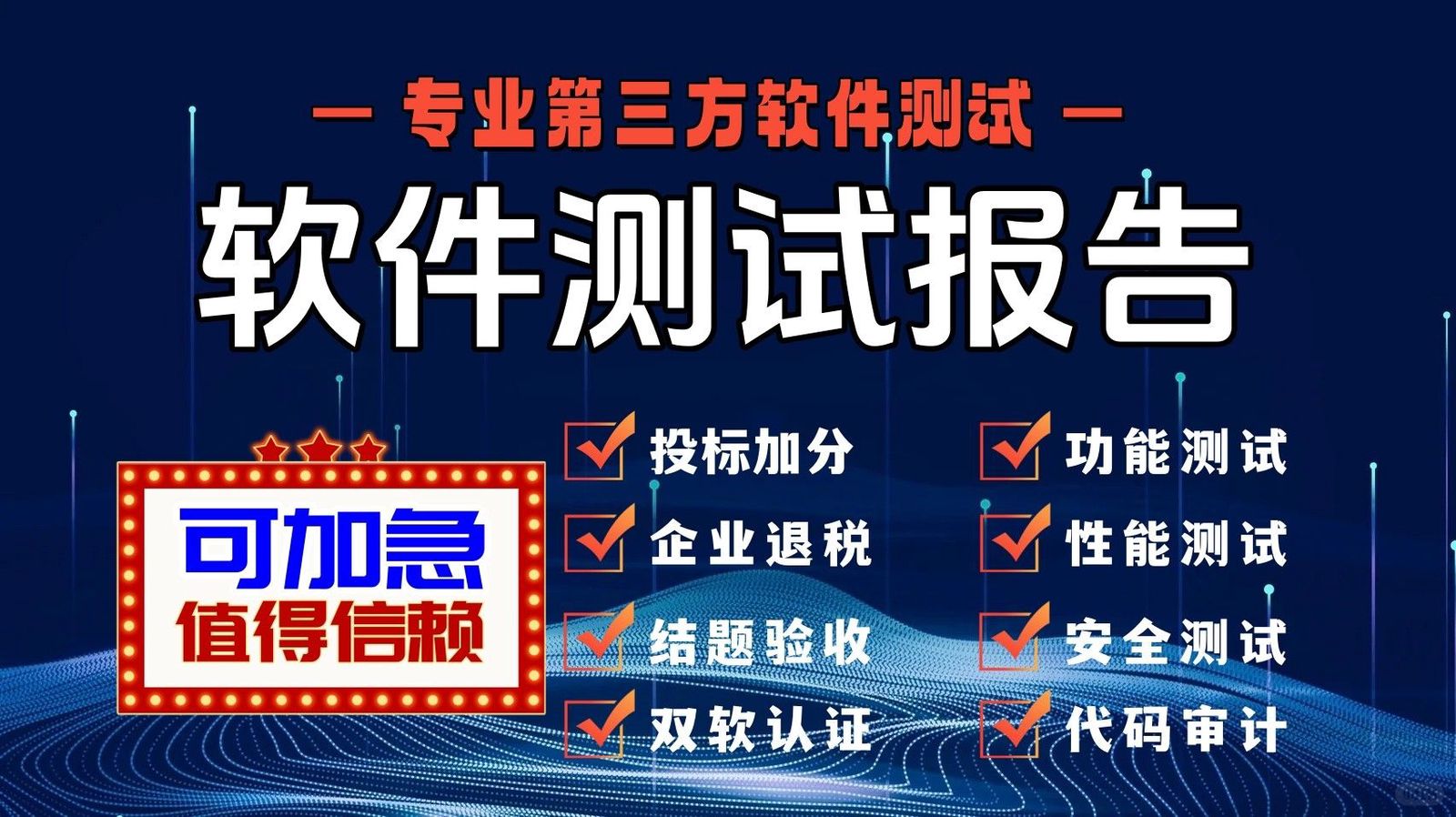
In the entire life cycle of software development, acceptance testing is a crucial link to ensure product quality, meet user requirements, and achieve successful project delivery. An authoritative and impartial "Software Acceptance Test Report" is not only a "pass" for project conclusion, but also an important basis for bidding and tendering, government project application, customer acceptance, and internal quality control of enterprises. So,
How can one apply for a software acceptance test report efficiently and standardly?
To apply for a software acceptance test report, it is usually necessary to select a qualified testing institution and then submit the application and relevant documents as required, including the "Application Form for Entrusted Testing", "Operation Manual", "Research and Development Task Book", etc. The testing institution will conduct professional tests and issue a formal report. The final report will be signed and sealed by the institution's responsible person to take effect. Below, we break down this process into four core steps to provide you with a clear action guide.
I. Careful Preparation: Laying the foundation for a successful application
"Preparation leads to success; lack of it leads to failure." " Before officially launching the application process, thorough preparation can achieve twice the result with half the effort and ensure a smooth and efficient subsequent process.
1. Clarify the testing requirements and objectives
First of all, you need to have in-depth communication with the potential testing institution and clearly explain the core purpose of this test. Is it for the completion of the final acceptance of government projects? Or is it to showcase the product's advantages in the bidding process? Or is it to prove the stability and reliability of the product to important customers? Different uses determine the focus and depth of the test.
For example, reports for government projects may need to strictly follow national standards (such as GB/T 25000.51), while products for the market may pay more attention to performance and user experience. After clarifying the requirements, jointly determine the testing scope with the testing institution, which only includesFunctional testingIt still needs to cover multiple dimensions such as performance, security and compatibility.
2. Choose a professional third-party testing institutionShangtuo Cloud Measurement
Choosing a reliable testing agency is the top priority of the entire process. A professional third-party organization can not only provide objective and fair test results, but also discover potential problems with its rich experience. When making a choice, it is important to focus on the following points:
Authoritative qualifications: Give priority to institutions that possess CMA (China Metrology Accreditation) and CNAS (China National Accreditation Service for Conformity Assessment) qualifications. These two qualifications are the "golden signboards" of professionalism and authority for testing institutions. The reports they issue have legal effect and wide credibility throughout the country.
Technical strength and industry experience: Examine whether the technical team of the institution has rich testing experience, especially project experience in your industry. For instance, the testing focuses and compliance requirements for software in different fields such as finance, healthcare, and government affairs vary.
Service reputation and case studies: By examining an institution's customer cases and market reputation, one can indirectly understand its service quality and professional level.
Take the well-known institution Shangtuo Cloud Test in the industry as an example. It not only holds dual qualifications of CMA and CNAS, but also gathers a team of senior test engineers. It has served numerous large enterprises and government projects and can provide comprehensive test solutions ranging from functionality, performance to security. It is a trustworthy choice.

Ii. Standardized Application: Submit materials step by step
After all the preparations are completed, the application process can be officially initiated. The core of this stage is to submit all necessary information and materials in a standardized and accurate manner.
1. Submit the preliminary application
Firstly, submit a preliminary application to the testing institution you have selected, such as Shangtuoyun Testing. This can usually be done through its official website's online application system, customer service hotline, or dedicated account manager. You need to provide basic information about the software, such as software name, version number, whether it has been fully developed, development language, deployment environment, etc., in order for the organization to conduct preliminary evaluations, such as assessing the testability of the tested item.
2. Prepare and submit core materials
This is the most meticulous and crucial part of the entire application process. The testing institution will provide a detailed "Application Form for Entrusted Testing" and a list of materials. You need to prepare them strictly in accordance with the requirements. Usually includes:
1). Application Form for Entrusted Testing:This is a formal legal document that requires the filling in of client information, software information, testing requirements, testing basis, etc. It is essential to ensure the accuracy of the information.
2)Software test object:
Web system: Provides a stable access address for the test environment, as well as test accounts for administrators and various roles.
App/ client software: Provide software installation packages that can be installed and run normally (such as APK, IPA, EXE, etc.).
4)"Operation Manual" or "User Manual" :Help testers understand the business logic and expected operation process of the software, and ensure that the testing starts from the user's perspective.
5)Performance index requirements (if involving performance testing) :Clearly define the performance metrics you expect to achieve, such as: expected concurrent user numbers, average response time for core transactions, throughput (TPS), etc.
6)"Research and Development Task Book" or project-related documentsProviding the research and development background, target users, and design intent of the software can help testers gain a deeper understanding of the product.
3. Sign a formal commissioning testing contract
After the testing institution reviews and approves the materials you submitted, both parties will sign a formal commissioning testing contract. The contract will clearly stipulate the scope of the test, test content, test cycle, cost, deliverables (types and quantities of reports), confidentiality clauses, as well as the responsibilities and obligations of both parties. The signing of the contract marks the formal establishment of the entrustment relationship and also provides legal guarantee for the cooperation between the two parties.

Iii. Test Execution and Report Generation
After the contract is signed, it enters the core stage of testing execution and report generation. You just need to be patient, and a professional testing team will start working.
1. Professional test execution
Engineers of the testing institution will formulate detailed test plans and test cases in accordance with national standards (such as GB/T 25000.51-2016) and contract requirements. Subsequently, it is systematically executed in the standard test environment that has been set upFunctional testing/Performance testOr other agreed test types. Any defects (bugs) discovered during the testing process will be recorded in the defect management system and we will communicate with you regularly so that your development team can fix them in a timely manner. After the fix, the testing team will also conduct regression testing to ensure that the problem has been completely resolved and no new issues have been introduced.
2. Report writing and internal audit
After all the testing work is completed, the test engineer will start to write the "Software Acceptance Test Report".
The report content usually includes: test overview, test environment, test scope and basis, test case execution status, defect statistics and analysis, test conclusion, etc. This report is not only a list of test results, but also a comprehensive evaluation of the software quality. After the initial draft of the report is completed, it will undergo multiple internal reviews by the test project leader, technical manager, etc., to ensure the objectivity, accuracy and professionalism of the report.
3. Report issuance and stamping
The report that has been reviewed and found to be correct will be submitted to the authorized person in charge of the institution (such as the technical director or quality director) for final signature. After issuance, the institution will affix its official seal, especially the special seal of CMA or CNAS. This marks the official effectiveness of the report, which has legal effect and authority.
4、 Report delivery and follow-up services
The final step is to receive this test report that embodies professionalism and rigor.
1. Deliver the report
Testing institutions usually provide both electronic (PDF format) and paper versions of the report as stipulated in the contract.
Paper reports will be stamped with a fresh seal and are suitable for formal archiving and submission.The delivery method is express delivery;
The electronic version (scanned copy of the test report with the official seal) is convenient for your internal circulation and digital management. The delivery methods are wechat, QQ and email.
2. Follow-up guidance and support
Responsible testing institutions (such as Shangtuo Cloud Testing) will also provide subsequent guidance services after delivering the report. For instance, we will provide you with a detailed interpretation of the professional terms and data in the report, analyze the root causes of the defects, and offer improvement suggestions. In addition, when you encounter questions when submitting reports to clients or reviewers, the institution can also provide necessary support to help you better leverage the value of the report.