
Analysis of the General Standard GB-T 25000.51-2016 for Independent Software of Medical Devices
Analysis of the General Standard GB/T 25000.51-2016 for Independent Software of Medical Devices
We know that for a medical device to be registered as a product, the first step is to obtain a registration inspection report. What general standards are used to inspect independent software products? How can our enterprise ensure that the products meet the standards? Today, let's explore it together.
General standards for independent software
According to the content of the "Guiding Principles for Technical Review of Medical Device Software Registration"
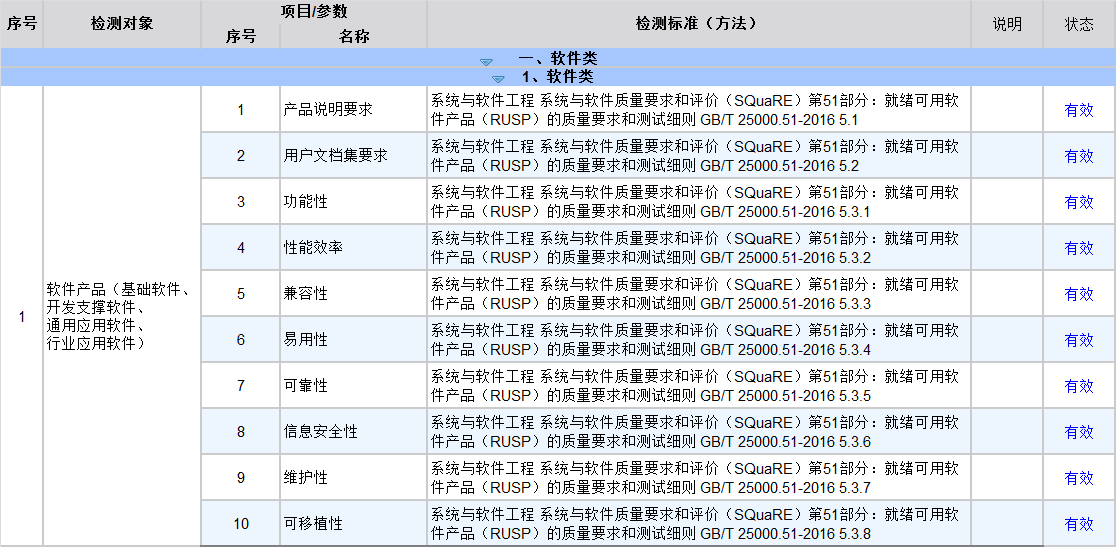
The technical requirements for independent software products should clearly specify the software's name, model specification, release version and version naming rules in the "Product Model/Specification and Its Classification Description". The "performance indicators" are divided into general requirements, quality requirements, specific requirements and safety requirements. Among them, the general requirements should be standardized according to the software's own characteristics. The quality requirements shall comply with the requirements of GB/T 25000.51 "Software Engineering - Quality Requirements and Evaluation of Software Products (SQuaRE) - Quality Requirements and Test Details for Commercial off-the-shelf (COTS) Software Products", and the specific requirements shall comply with the requirements of relevant performance standards (such as radiotherapy) Safety requirements should comply with the relevant safety standards (such as alarm and radiotherapy).
The guiding principles clearly state that the general standard adopted by independent software is GB/T 25000.51-2016. The specific requirements are determined based on the specific application scope of the software. Therefore, every independent software product needs to undergo registration inspection in accordance with GB/T 25000.51-2016.
The structure of the GB/T 25000.51-2016 standard
We will not elaborate on the background of the standard here. Let's focus on the standard table of contents. From the table of contents, we can roughly determine what the key points of the standard are. We can see that the GB/T 25000.51-2016 standard has the following chapters:
① Scope
② Conformity
③ Normative references
④ Terms and definitions, abbreviations
⑤ Requirements of RUSP
Product description requirements
User document set requirements
Software quality requirements
⑥ Requirements for the test document set
⑦ Detailed rules for conformity assessment
⑧ Appendix and References
From the table of contents, we can see that the requirements of RUSP are divided into three parts: product description, user documentation set and software quality. At the same time, a test document set is required. Therefore, when we prepare the inspection documents for our products, the key points are these several documents. Let's take a look at each file one by one below
Product Description
Product descriptions are documents that state the various properties of software. The main purpose is to assist potential demanders in conducting an applicability evaluation of the software before procurement.
In simple terms, a software instruction manual is a pre-sale manual. And it is a very detailed pre-sale manual. In the product description, enterprises need to display all the basic information of the software, its intended use, application scope, usage environment, user qualifications, software functions, software quality characteristics and software maintenance, etc.
User Document set
The user documentation set is the information provided along with the software to assist users in using the software. That is the product manual.
Here, we need to focus on comparing the product description with the user documentation set. For the product instructions of medical devices, information such as the intended use should also be clearly stated. That is to say, the user documentation set is based on the product description and adds content related to product operation.
Description of software quality
The definition of software quality is derived from GB/T 25000.10-2016 "Systems and Software Engineering - Systems and Software Quality Requirements and Evaluation (SQuaRE) - Part 10- Systems and Software Quality Models". The standard stipulates the framework of the quality model, the quality model to be used and the product quality model. The 25000.51 standard requires enterprises to describe the quality of use and product quality. The key point is to describe the product quality.Product quality is divided into eight aspects, namely: functionality, performance efficiency, compatibility, ease of use, reliability, information security, maintainability and portability.
Test document
The purpose of the test document is to verify that the software complies with the product quality claimed by the enterprise. That is to say, enterprises not only need to write product quality descriptions, but also need to conduct corresponding tests on product quality to prove that the software meets the requirements. The GB 25000.51-2016 standard stipulates that test documents should include test plans, test cases, test instructions and test reports. The standard sets requirements for the content of product descriptions and user documentation sets. For example, Clause 6.1.4.10 of the standard states, "All operational limitations specified in the product description and user documentation set shall be tested through test cases."
The interpretation of this standard is that medical device software will definitely have some operational restrictions, such as software user permissions, only doctors with designated qualifications can operate the software, etc. For these operational restrictions, enterprises need to express them in the product descriptions and user documentation sets. At the same time, merely expressing is not enough. It is also necessary to conduct tests based on test cases. Only after passing the tests can it be proved that this function is compliant.

From the above, we can see that it is still rather difficult for independent software products of medical devices to comply with the GB/T 25000.51-2016 standard.Enterprises need to write product descriptions and user documentation sets based on the software and formulate quality characteristics. It is also necessary to write test plans and test cases based on the above content. Finally, conduct the test and form a test report. Only after all the tests are passed can it be considered to meet the standards.Once the software is updated, the updated content still needs to be retested. Therefore, it is recommended that enterprises incorporate the content of standards from the software project initiation and planning stage, formulate good product quality and usage quality characteristics, and strictly implement tests.