What is the latest version of the national standard for software Testing GB-T 25000.51-2016?
GB/T 25000.51-2016 "Systems and Software Engineering - Systems and Software Quality Requirements and Evaluation (SQuaRE) - Part 51: Quality requirements and test Rules for Ready and Usable Software Products (RUSP)" is the core national standard in the field of software quality evaluation in China. This standard is under the jurisdiction of the National Technical Committee for Information Technology Standardization. It was officially released on October 13, 2016 and came into effect on May 1, 2017. As of now, the latest version of this standard is still the 2016 edition. The National Information Technology Standardization Technical Committee has not yet released a revised version or an alternative standard.

The core content and quality characteristics of the standard
GB/T 25000.51-2016 systematically defines the quality requirements and test details for software Ready for Use (RUSP) products. Its core framework is centered around eight quality characteristics, covering the quality requirements throughout the software life cycle:
1. Functionality: Verify whether the software fully implements the functional points in the requirements specification, including the correctness of business logic, the compliance of permission management, and the effectiveness of data encryption.
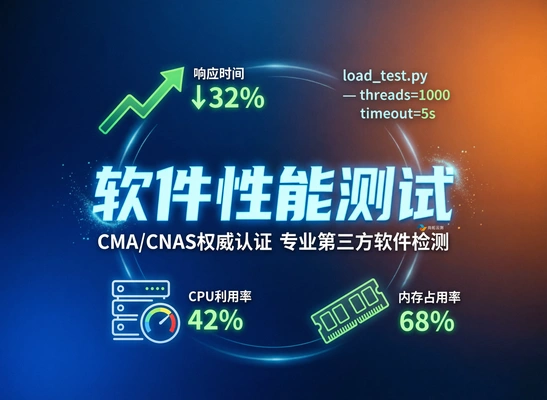
2.Performance efficiency: PassedPressure testResource monitoring (CPU/ memory usage rate) and capacity testing (such as the number of concurrent users) to evaluate the system's response time and stability under high load.
3.Compatibility: It examines the software's adaptability in multiple operating systems (Windows/Linux), databases (MySQL/Oracle), and hardware environments, emphasizing coexistence and interoperability.
4.Information security: Based on penetration testing and vulnerability scanning (such as defending against SQL injection /XSS attacks), ensure the confidentiality, integrity and non-repudiation of data.
5.Reliability: Simulate abnormal scenarios such as network disconnection and power outage to verify the system's fault tolerance and fault recovery efficiency.
6.Usability: Review the clarity of user documentation, test the intuitiveness of interface interaction and the friendliness of error prompts.
7.Maintainability: Analyze the modularization degree and readability of the code to reduce the cost of later upgrades and maintenance.
8.Portability: Test the software's cross-platform installation, migration and replacement capabilities to ensure environmental adaptability.
The standard requires that the test document set should include the test plan, test case design (covering boundary values and abnormal scenarios), and execution reports, providing a basis for compliance evaluation.
The application value and implementation status of the standard
This standard is widely applied in software product acceptance, third-party testing and industry compliance assessment. During the on-line testing of the power system, the testing institution conducts a comprehensive assessment based on its functional integrity, performance indicators and security requirements to ensure that the system meets business needs. Third-party testing institutions such as "Shangtuo Cloud Testing" issue legally binding assessment reports based on this standard, serving the bidding and acceptance scenarios of government and enterprise projects.
Since the implementation of the standard, it has become a member of the China National Accreditation Service for Conformity AssessmentCNASIt is an important basis for laboratory accreditation and promotes the standardization of software testing processes. Its synchronization with the international standard ISO/IEC 25051:2014 has further enhanced the international mutual recognition of China's software quality evaluation system. Despite the rapid development of information technology, GB/T 25000.51-2016 continues to provide stable and authoritative benchmark support for software quality through its universal framework and detailed requirements.