【 Standard 】 Summary Introduction of National Standard GB-T 25000.51-2016

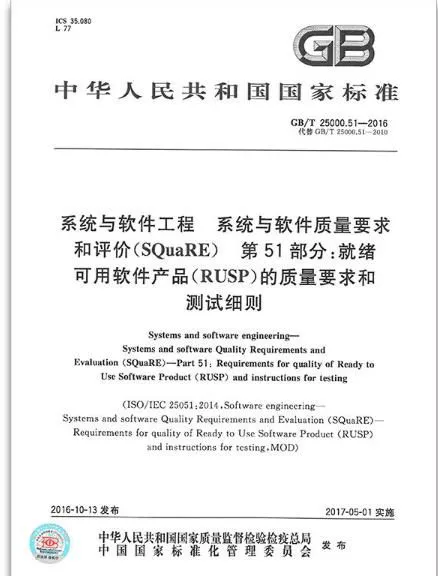
GB/T 25000.51-2016 is a Chinese national standard, which is equivalent to the international standard ISO/IEC 25051:2014 and has been adjusted in some provisions. The full name of this standard is "Systems and Software Engineering - Systems and Software Quality Requirements and Evaluation (SQuaRE) - Part 51: Quality Requirements and Test Details for Ready-to-use Software Products (RUSP)". Its main objective is to establish unified quality requirements, testing methods and compliance evaluation norms for "Ready-to-use Software Products" (RUSP).
Core concept
RUSP (Ready to Use Software Product) refers to software products that can be used directly without users engaging in development activities, such as office software, database management systems, embedded software, mobile applications, Web applications, etc. It does not include open-source software or custom-developed software. The feature of RUSP is that it can be directly delivered to users for use and usually comes with a complete set of user documentation and product descriptions.
Scope of application
This standard is applicable to various types of RUSP providers, certification bodies, testing laboratories, regulatory authorities and end users. It not only stipulates the quality requirements of RUSP, but also clarifies how to verify these requirements through the test document set and how to conduct compliance evaluation. In addition, the standard also provides supplementary guidelines for business or security-critical application scenarios.
Main content
1. Quality Model and quality Requirements
According to the quality model of GB/T 25000.10-2016, the quality of RUSP is divided into two dimensions:
Product quality: including functionality, performance efficiency, compatibility, ease of use, reliability, information security, maintainability and portability.
Usage quality: covering effectiveness, efficiency, satisfaction, risk resistance capacity and environmental coverage.
Each quality characteristic has a corresponding sub-characteristic, for example:
Functionality: Completeness of functions, accuracy, and suitability;
Usability: Recognizability, ease of learning, and ease of operation;
Reliability: Maturity, fault tolerance, and recoverability;
Information security: Confidentiality, integrity, non-repudiation;
Portability: adaptability, ease of installation, and replaceability.
2. Product description requirements
Product descriptions are an important part of RUSP and should include the following contents:
Clear product identification (name, version, release date);
A detailed description of the software functions;
The hardware and software configurations required for operation;
Supported services and maintenance information;
Compliance statement (whether it complies with relevant laws and regulations);
Compatibility information (specific software and hardware relied upon);
Security mechanisms (such as preventing unauthorized access);
Performance limitations (such as maximum data capacity, resource consumption);
User interface types and usage requirements.
3. Requirements for the user document set
The user document set is a key material to help users understand and correctly use RUSP and must meet the following requirements:
The content is complete, covering all functions and usage scenarios.
Easy to understand, with clear terminology and a reasonable structure;
Including installation guides, backup and recovery instructions, and frequently asked questions;
Be consistent with the product description to avoid conflicts;
Support multi-language versions (if necessary);
It includes necessary technical details, such as system configuration requirements, interface descriptions, etc.
4. Software quality requirements
The software itself should meet the following basic requirements:
Functional correctness: All functions should operate normally according to the user documentation description;
Performance consistency: Under the specified environment, the software response time, resource occupation and other indicators should meet expectations.
Reliability: Equipped with a fault-tolerant mechanism to ensure that data loss will not occur under abnormal circumstances.
Security: Provide access control, data encryption and other mechanisms to prevent unauthorized access;
Maintainability: Facilitates defect diagnosis and repair;
Portability: Supports installation and operation on multiple platforms and configurations;
Usability: User-friendly interface, clear error prompts, and intuitive operation process.
5. Requirements for the test document set
To verify whether RUSP meets the above quality requirements, the standard has put forward detailed requirements for the test document set, mainly including
Test plan: Clearly define the test objectives, test environment, schedule, risk management and communication mechanism;
Test Instructions: including test cases, test procedures, input data, expected output and judgment criteria;
Test results: Record the test execution process, discovered anomalies and their handling situations, and provide the verification results of the re-test.
The test document set should ensure completeness, accuracy and traceability to comprehensively reflect the quality status of the software.
6. Detailed Rules for Conformity Evaluation
Conformity assessment is a systematic evaluation of whether RUSP meets the standard requirements. The evaluation process includes:
Product description review: Check whether the product description complies with the standard requirements;
User document set evaluation: Ensure the completeness, accuracy and consistency of documents;
Software testing and verification: Conduct tests based on the test documentation set to confirm software quality.
Generate a compliance report: Summarize the evaluation results and form a formal compliance evaluation report.
The evaluation organization can be a third-party testing institution, certification body or independent laboratory. The report should include the RUSP logo, test environment, test results, list of non-conformities and other contents.
7. Additional recommendations for business or safety-critical systems
For application systems involving high risks (such as medical equipment, aerospace, financial transactions, etc.), the standard provides additional technical recommendations in Appendix A, including:
Fault detection and Redundant design
Multi version programming;
Restore block program design;
The use of encapsulation programs;
Storage protection and resource management;
Fault-tolerant mechanism and interrupt handling
RUSP integration strategy in Embedded systems.
These measures are aimed at enhancing the stability and safety of RUSP in high-risk environments.
GB/T 25000.51-2016 provides comprehensive technical specifications for the quality management and testing of RUSP, covering the entire process from product descriptions to user documentation, software functions, test procedures to conformity evaluation. This standard is not only applicable to software suppliers, but also provides a unified assessment framework for certification bodies, testing laboratories and regulatory authorities. For enterprises, adhering to this standard helps enhance the market competitiveness of software products, increase user trust, and reduce potential risks caused by quality issues.